

Blog & Case Studies

TOM Attribute No. 1: Scope and Remit

“Leadership is More About Clarity than it is About Control.”

INTRODUCTION

What do legal professionals, police officers and fire fighters all have in common? Their performance depends on role clarity. In my previous article, I described seven critical attributes for legal department performance. This piece delves into the first attribute: “Scope and Remit.” Scope and Remit emphasizes the importance of clear accountabilities, roles and responsibilities for individuals and groups. Moreover, it underscores the need to proactively maintain this clarity.

OVERVIEW
The need for clarity has become even more critical as our world becomes increasingly volatile, uncertain, complex and ambiguous (“VUCA”).1  The Information Age, marked by an explosion of big data and rapid advancements in artificial intelligence, amplifies VUCA conditions. Legal professionals, like other knowledge workers, are particularly affected by this rapidly changing, tech-driven environment where information multiplies at an unprecedented rate. It is no surprise that the legal industry is both excited by the potential benefits of generative AI and simultaneously overwhelmed by the uncertainty it brings. One certainty remains: while technology significantly enables human capital, human performance continues to be key for the workforce of the future. Complex problem-solving in a VUCA world requires engaged individuals and teamwork. Well-defined and understood scope and remit is a critical, yet often overlooked, driver of individual human performance and teamwork. While this concept may seem straightforward, it remains a challenging issue for organizations, public agencies and inhouse departments alike, often with serious consequences.
THE IMPORTANCE OF ROLE CLARITY

Role clarity drives individual performance and performance between teams.
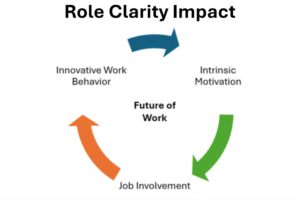
A. Individual Performance. Role clarity significantly influences individual engagement, effectiveness, attitude and retention rates. Research has shown that it increases job satisfaction, commitment and involvement while reducing tension and anxiety.2
Study 1: Optimal Performance. A 2019 study found that role clarity impacts an individual performer’s intrinsic motivation, job involvement and innovative work behavior (“IWB”) – all critical components for the workforce of the future.3
  1. Intrinsic Motivation. Intrinsic motivation refers to performing an activity for inherent enjoyment and satisfaction.4 It is a key component of knowledge work, which requires creativity and resilience. Role clarity increases intrinsic motivation by clearly tying effort to specific outcomes.5 Studies show that intrinsically motivated employees are highly engaged with their work and less likely to leave. Intrinsic motivators are three times more effective than extrinsic motivators and employees become more innovative when they are intrinsically motivated.6
  2. Job Involvement. Job involvement is the extent to which an individual is psychologically connected to their job and actively participates in it. It measures how
    much an employee identifies with their work and derives a sense of self-worth from it. Role clarity positively influences job involvement by, among other things, reducing unnecessary confusion. Employees become more innovative as job involvement increases. Conversely, role uncertainty erodes job involvement.7
  3. Innovation. An organization’s ability to innovate largely depends on the IWB of individual employees. IWB refers to behavior aimed at initiating and intentionally
    introducing new and useful ideas, processes, products or procedures. Clear role definitions enable employees to engage in IWB, while lack of role clarity inhibits this
    behavior by causing stress, which is highly detrimental to creativity.

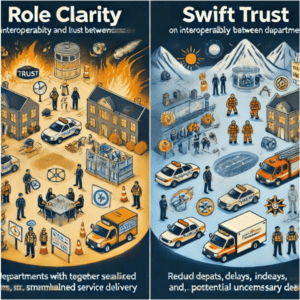
B. For Interoperability Between Departments. Role clarity also impacts interoperability between departments by either encouraging or eroding “swift trust.” Swift trust is a unique form of trust that develops between individuals or groups without prior relationships when they are brought together in temporary teams to accomplish specific tasks, often under time constraints. This type of trust influences how these groups address uncertainty, vulnerability, risk andexpectations. The benefits of swift trust include reduced costs, improved relationships, streamlined service delivery and better information sharing. Conversely, its absence can lead to delays, increased risk and, in the case of public safety departments, unnecessary loss of life.

Study 2: Project Managers and Trust. In 2020, the University of Cambridge conducted a study of 177 project managers to determine the basis for swift trust.8 Project managers were chosen as ideal study candidates because their work revolves around establishing trust within temporary teams with no prior relationships. The study revealed two key drivers for swift trust:

  • Role clarity
  • The likelihood of team members working together again in the future (referred to as the “shadow of the future”)9

The researchers emphasized that few factors impede the formation of swift trust more than inconsistent or blurred role definitions within a project team.

Study No. 3: Effective Teams in Public Safety. The Battalion Chief of New York City’s fire department found similar results in the public sector, where terrorist attacks, natural disasters and high-consequence accidents are too complex for any single agency to manage independently.10 In such cases, a lack of coordinated response between agencies can lead to greater loss of life and property, as well as longer recovery times following an incident.

Chief Fahy demonstrated that the NYPD and FDNY’s ability to make critical decisions together in the early stages of an incident make the difference between life and death. The study found that swift trust between the NYPD and FDNY resulted from establishing:

  • Well-defined roles
  • Clearly defined tasks
  • Clear communication paths
CONSEQUENCES OF LOW MATURITY IN LEGAL

Study 4: Avoiding Legal. Onit’s annual 2023 Enterprise Legal Reputation (ELR) Report surveyed 4,000 non-legal employees and 500 corporate legal professionals across the US, UK, France and Germany. The report emphasized that clear communication and collaboration are essential for interoperability between Legal and business stakeholders.11 This inevitably includes clear scope and remit.

The study also revealed that risk is amplified amid geopolitical and economic uncertainty (i.e., VUCA conditions). For instance, in Germany, where the Ukraine invasion led to high inflation, energy-price volatility and order backlogs, quality of interaction scores between Legal and both Sales and Marketing departments plummeted to 23 and 25 percent, respectively.
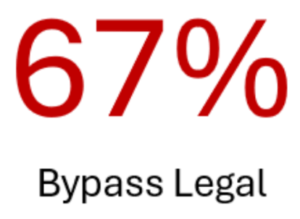
Key findings:

  • 67% of business stakeholders admitted bypassing Legal despite knowing it was against company policy, due to poor communication, collaboration and inefficiency.
  • Surprisingly, 91% of Legal respondents acknowledged this avoidance.

The report also highlighted a significant disconnect between Legal’s perception of its interactions with business stakeholders and the stakeholders’ ratings of those same interactions. In one case, Legal rated the quality of interaction three times higher than the business stakeholders did. This overestimation by Legal was consistent across all business stakeholder groups.

Study 5: Burnout and Bandwidth. Our Target Operating Model (“TOM”) design consulting engagements have corroborated these findings. For example, the general counsel of a business group for a Fortune 100 technology company inherited a new team of senior legal professionals (“SLP”). The SLP’s role is to bring new technologies to market by advising business planners and engineers on legal and regulatory matters, requiring deep integration with business stakeholders. Faced with the challenge of doing more with less amid rapid company growth, the general counsel engaged our team to design the SLP’s future state operating model.

Our current state analysis revealed:

  1. Business stakeholders lack clarity on the SLP’s scope and remit.
  2. Stakeholders often reach out to the SLP for help outside the SLP’s scope of responsibility.
  3. SLP team members typically assist these requestors in finding the right resource, costing them valuable time and energy.

As the business grows and volumes increase, this operational gap will likely contribute to:

  • SLP undercapacity
  • Reduced efficiency
  • Low-quality interactions

Even more concerning, research indicates that this type of environment often leads to burnout and attrition.12

PRACTICE TIPS AND INSIGHTS

Given the above findings, here are several tips for maturing Attribute No. 1:

  1. Assess your environment. Based on research and firsthand experience, many legal departments likely have low maturity in this area. Legal leadership may not realize there is a problem, understand its root causes or fully grasp its impact. A well-structured assessment can uncover these issues and set the course for resolution. Remember: a problem well-defined is a problem half solved.
  2. Maintain an accurate perception of business stakeholders. The ELR Report revealed that legal department participants often had an overly optimistic view of their interactions with business stakeholders. This knowledge gap contributes to business stakeholders bypassing the legal department. As the chief risk mitigators in any organization, legal departments must recognize that operational inefficiency, poor interoperability and inaccurate views of business stakeholder satisfaction increase organizational risk. Know your customer, because the customer is (almost) always right.
  3. Identify cultural constraints. As seen in the “Burnout and Bandwidth” case study, lawyer culture encourages client-centricity. While this is generally positive, it can be detrimental to Legal’s mission if not properly managed. To better maintain bandwidth in a “do more with less” environment, legal leaders should be judicious about which business stakeholders and issues receive white-glove service. There simply is not enough time in the day for everyone and everything.
THE BOTTOM LINE

In a VUCA world, the ability to generate novel ideas, adapt to change and solve complex problems is critical. Role clarity motivates team members and a motivated team is better positioned to innovate and tackle complex challenges. Therefore, clearly defined and understood scope and remit are crucial.

The consequences of low maturity in this area include:

  • Substantially reduced quality of interactions with business stakeholders
  • Prolonged timelines
  • Disengaged team members

Ultimately, these issues can lead business stakeholders to bypass legal departments altogether, increasing organizational risk.

The next article in this series will dive deep into Attribute No. 2: Staffing Model.

  1. Bennett, N., & Lemoine, G. J. (2014). What VUCA Really Means for You. Harvard Business Review, 92(1/2). https://hbr.org/2014/01/what-vuca-really-means-for-you. VUCA is an acronym that the U.S. military uses to describe our current global environment. It stands for volatile, uncertain, complex, and ambiguous.
  2. Kundu, S.C., Kumar, S. and Lata, K. (2020), “Effects of perceived role clarity on innovative work behavior: a multiple mediation model”, RAUSP Management Journal, Vol. 55 No. 4, pp. 457-472. https://doi.org/10.1108/RAUSP-04-2019-0056.
  3. Using multiple regression analysis, Kundu et al. found an effect size for role clarity’s influence on intrinsic motivation, job involvement, and innovation to be β = 0.491, 0.500, and 0.471 respectively, with a p-value <= 0.001, indicating a significant positive relationship.
  4. Deci, E. L., & Ryan, R. M. (1985). Intrinsic motivation and Self-Determination in human behavior. New York, NY: Springer Science & Business Media.
  5. Tubre, T. C., & Collins, J. M. (2000). Jackson and Schuler (1985) revisited: A meta-analysis of the relationship between role ambiguity, role conflict and job performance. Journal of Management, 26, 155-169.
  6.  Kundu citing Bysted, R., & Hansen, J. (2013). Comparing public and private sector employees’ innovative behavior. Public Management Review, 17, 1-20.
  7. Brown, S. P. (2007). Job involvement. In S. G. Rogelberg (Ed.), Encyclopedia of industrial and organizational psychology (pp. 397-399). Thousand Oaks: Sage Publications.
  8. Jarvenpaa, S. L., Shaw, T. R., & Staples, D. S. (2020). How to create trust quickly: A comparative empirical investigation of the bases of swift trust. Cambridge Journal of Economics, 45(4), 1-22. https://doi.org/[DOI 10.1093/cje/beaa041]
  9. The results of OLS regressions indicated that, controlling for the effects of sociodemographic and workrelated characteristics, role clarity positively predicted all dimensions of swift trust: benevolence (β = .24, p < .001), ability (β = .50, p < .001), and integrity (β = .45, p < .001).
  10. Fahy, M. J. (2012). Understanding “Swift Trust” to Improve Interagency Collaboration in New York City [Master’s thesis, Naval Postgraduate School]. Naval Postgraduate School Institutional Archive.
  11. Onit. (2023). 2023 Enterprise Legal Reputation Report: How Legal Teams Impact Revenue and Business Growth. Onit, Inc.
  12. For more information, see my previous article describing how low maturity in scope and remit led to employee attrition at a Fortune 100 company.