

Series Context: This is the prologue to a 12-month executive curriculum, The Executive Toolkit to Unlock Modern Legal, built on a four-layer Legal Executive Leadership System: Diagnostic, Structural Design, Change Engine, and Measurable Business Outcomes. Each monthly installment delivers frameworks, diagnostics, and actionable guidance for CLOs, GCs, DGCs, and AGCs leading operational transformation. Month 0 addresses the precondition that everything else rests on: the leader’s own readiness.
You sit down in the chair. General Counsel. Chief Legal Officer. Deputy General Counsel leading a critical function. The title is new, or perhaps you have held it for years and are only now confronting what it actually demands.
The realization arrives quietly: this job is not about better lawyering. It is about leading at scale, velocity and with actionable insight in a world propelled forward by AI. And the expectations change faster than most legal departments can adapt.
Legal departments do not struggle because their lawyers lack legal skill. They struggle because they are rarely intentionally designed, governed and evolved as operating systems. Law firm training, where the vast majority of legal leaders receive their professional formation, does almost nothing to prepare you for the kind of adaptive leadership that transformation demands.
This series exists to close that gap. But before we can discuss diagnostics, operating models, change sequencing, or ROI measurement, we must address a question that most legal leaders skip entirely:
Why are you here?
You, personally and specifically, are leading this team, at this organization, in this moment. The answer is not a motivational exercise. It is the first operating decision of your tenure, and every decision that follows will be shaped by whether you made it deliberately or left it to chance.
Let us first clear away a conflation that pervades legal departments: the assumption that management and leadership are the same activity.
They are not.
Management keeps a system stable and moving in its current direction through planning, budgeting, organizing, staffing and controlling. Good management is essential. It keeps the lights on and the contracts flowing.
Leadership is attracting people to follow as you establish direction, alignment, and motivate and inspire toward something new.
The distinction is not academic. It determines whether your transformation effort has an engine or just a steering wheel. You can manage a legal department competently for years without ever leading it. The contracts get reviewed, the litigation gets handled, the regulatory filings go out on time. But the function does not evolve. It does not create new capacity. It does not become more valuable to the enterprise. It simply persists.
Here is why this matters: When you undertake real transformation (redesigning the operating model, deploying new technology, shifting how work gets allocated), the existing management infrastructure rarely keeps pace. Incentive structures, cultural norms, performance systems, reporting lines all tend to trail in their adaptation. Your leadership must fill the void and help close the gap.
Purpose is the fuel for your leadership. Without it, you are asking people to follow you into uncertainty on the strength of your title alone. Titles create compliance. Purpose creates commitment.
| Management | Leadership | |
|---|---|---|
| Core function | Stability and execution | Direction and alignment |
| Primary question | How do we do this well? | Why should we go there? |
| Source of authority | Position and process | Purpose and credibility |
| Relationship to change | Absorbs and controls it | Initiates and guides it |
The emotional intelligence literature offers a useful progression: self-awareness, other-awareness, self-management, other-management. The sequence matters. You cannot effectively lead others through change if you have not first examined your own motivations, preferences, and operating patterns.
This is not therapy. It is preparation.
Three bodies of work converge on the same foundational insight and deserve a place on every legal executive’s reading list:
Simon Sinek’s Start With Why frames purpose as the core, surrounded by how you do it and what you do. Most leaders communicate from the outside in. The compelling ones communicate from the inside out.
Peter Drucker’s “Managing Oneself” pushes further. Drucker argues that knowledge workers must understand their strengths, how they perform, what they value, and where they belong. He was writing decades ago about what we now recognize as essential self-diagnostic work for any leader operating in complex environments.
Clayton Christensen’s “How Will You Measure Your Life?” completes the triad. Christensen’s challenge is deceptively simple: if you are going to spend enormous effort on something, have a theory of value, and make it personal. What do you value? What will you prioritize when the trade-offs get hard?
These frameworks converge on one practical insight: a leader with a clear, internalized “why” can sustain focus through ambiguity, make harder trade-offs with more consistency, and invest more fully in outcomes, because the work is personally meaningful, not merely professionally obligatory.
And here is the part that cannot be faked: people detect inauthenticity with remarkable speed. Human survival has always depended on scanning social signals for danger and that wiring has not disappeared. Teams do not just process a leader’s words. They ask, at a level that may never become conscious: Does this person actually believe what they are saying?
If you have not done the work of clarifying your “why,” that absence is legible. Once people sense your stated purpose and actual motivation are misaligned, trust erodes in ways that no communications strategy can repair.
And when you articulate your “why,” you are coding a signal to every person in the organization: Is this a transaction, or is this a relationship?
If your expression of purpose sounds like “I want to have adventures with people who grow and thrive,” people hear a relationship rather than a transaction. They will extend discretionary effort. They will take risks on your behalf. They will commit, not because they must, but because they believe you will take care of them when things get uncertain.
Key Question to Pressure-Test Your Why
Can you articulate your purpose in one sentence that a non lawyer would find compelling? If your “why” only resonates inside legal conferences, it has not been refined enough to lead cross-functional change.
Having a clear “why” is necessary but insufficient. Your purpose must also align with the organizational environment you operate in. Think of this as product-market fit applied to leadership — it is a diagnostic that most legal executives never run.
The Cube
Your “why” is not a single flat surface. It is a multi-faced object, a cube with many sides. You care deeply about one face. Your organization may find a different face far more compelling. Consider a leader whose core motivation is building teams that grow and thrive. That is one face of the cube. But the same leader’s work also produces cost savings, faster cycle times, and measurable risk reduction: different faces of the same object. The mature leader learns to turn the cube, showing the face that resonates with the audience while maintaining authenticity. The CFO needs to see the cost face. The business unit president needs to see the velocity face. The team needs to see the growth face.
The Script
Great actors do not succeed on talent alone. They succeed because they choose the right scripts. A marquee actor receives dozens of opportunities, filtered by agents and advisors, and must decide: Does this script align with my capabilities, my brand, and the audience I want to reach?
Legal leaders face the same decision, but most never frame it that way. The question is not just “Can I do this job?” It is: “Is this the right job for me to do for this organization? Does this organization’s definition of success align with the kind of leadership I am built to provide?”
If you are a highly relational leader and your organization defines success almost exclusively as cost reduction, you will be swimming upstream. You may build extraordinary team cohesion and unlock individual potential but if the scoreboard only tracks expense ratios, your wins will be invisible to the people who decide your future. That gap cascades to every person on your team, because when the leader is misaligned, the followers inherit the friction.
One metric worth considering: How many opportunities have you turned down? Not projects within your current role. Roles themselves. Jobs. Organizations. If the answer is “none” or “I never thought about it that way,” the diagnostic is overdue.
| Org Environment Aligned | Org Environment Misaligned | |
|---|---|---|
| Leader Purpose Clear | CATALYST Conditions favor compounding impact. The leader's authentic Leader Purpose expression attracts the right Clear opportunities, followers, and resources. Energy flows downstream. | MISSIONARY High effort, uncertain return. The leader is clear but the environment resists. Consider whether you can shift the environment, or whether you should choose a different script. |
| Leader Purpose Unclear | DRIFTER Riding favorable conditions without intentional direction. Leader Purpose Vulnerable to disruption when the environment shifts, because there is no internal compass to recalibrate against. | STALLED Neither internal clarity nor external support. Highest risk of burnout, team attrition, and quiet disengagement. The function persists but does not evolve. |
Once a leader has clarity of purpose and reasonable environmental alignment, the question becomes: How does that purpose land with others?
The answer lives at the intersection of two variables.
Credibility is whether people believe you are competent. Do you know the subject matter? Can you make sound judgments? Do you have the track record and the evidence to back your position? Credibility grabs the brain.
Conviction is whether people believe you believe. Do you walk forward with genuine commitment? Will you sustain your position when it gets uncomfortable? Do your actions align with your stated beliefs over time? Conviction grabs the heart.
The highest form of leadership grabs both.
| High Credibility | Low Credibility | |
|---|---|---|
| High Conviction | INSPIRATIONAL Passionate and credible. These leaders earn trust and respect simultaneously. Their influence compounds because people engage both intellectually and emotionally. Grabs the brain and the heart. | OVERZEALOUS Forceful and loud, but the foundation is thin. Passion may be mistaken for expertise, but substance-seeking followers will eventually disengage. Style over substance. |
| Low Conviction | MEASURED Calm and deliberate. Respected for knowledge and judgment, but rarely followed with fervor. Influence is real but bounded; it informs decisions without mobilizing energy. Brain without the heart. | INEFFECTUAL Neither trusted nor compelling. Messages lack impact. These leaders face chronic difficulty motivating others and building the coalitions that transformation requires. Neither brain nor heart. |
Here is the uncomfortable truth for legal leaders: law firm training builds credibility almost exclusively. Technical rigor, analytical precision, well-reasoned advice: these are the capabilities that earn partnership and, later, the general counsel title. But conviction? Inspiration? These words were almost certainly never spoken during your years as an associate. The preferred associates, if we are honest, were the ones who required the least investment, the ones who could be pointed at a problem and trusted to produce excellent work without supervision. That is a recipe for outstanding individual contributors. It is not a recipe for leaders who can move organizations.
Conviction is not something you manufacture. It flows from the work described in the preceding sections. If you have clarified your “why,” if you have tested its alignment with your environment, if you have found the authentic version of yourself that generates energy rather than draining it, then conviction is simply the external expression of internal clarity. That clarity is legible to the people around you.
The inverse is also true. If your “why” is borrowed, performative, or untested, the absence of genuine conviction will be visible no matter how polished the presentation. You can only close the conviction gap by going back to the foundational questions above.
Everything in this article (purpose, alignment, credibility, conviction) might sound like it belongs in a leadership retreat rather than an operating playbook. It does not. It belongs here because the work of transforming a legal function is overwhelmingly adaptive, not technical.
Technical problems involve straightforward issues solvable by experts using existing knowledge, tools or authority. Deciding between contract management system features, designing workflows, building a reporting dashboard: these have technical dimensions that can be planned and executed.
Adaptive challenges require people to change their beliefs, habits, and sense of identity. For adaptive challenges, there is no ready solution. Every change initiative in a legal department is, in practice, an adaptive challenge. You are not just implementing a contract management system. You are changing how people work, how they perceive their competence, how they understand their status within the organization. You will need real leadership fueled by purpose, alignment, and conviction.
This is the trap that legal leaders and their advisors fall into repeatedly. “It’s just a new system.” “It’s just a process change.” “It’s just a reorganization.” And the implicit assumption embedded in every “just” is that the challenge is technical: follow the implementation plan, check the boxes, go live. But when the system changes how a senior attorney spends their day or when the process change exposes that a team’s output was never measured before, the challenge is adaptive, and the leader’s approach must be adaptive too.
The difference between technical and adaptive leadership determines whether transformation stalls at the first sign of resistance or sustains momentum through years of iterative change.
Authentic purpose does not only serve the individual leader. It creates a replicable pattern that scales the organization’s leadership capacity, and that is ultimately what separates a legal function that can sustain transformation from one that depends on a single heroic individual.
The pattern works like this:
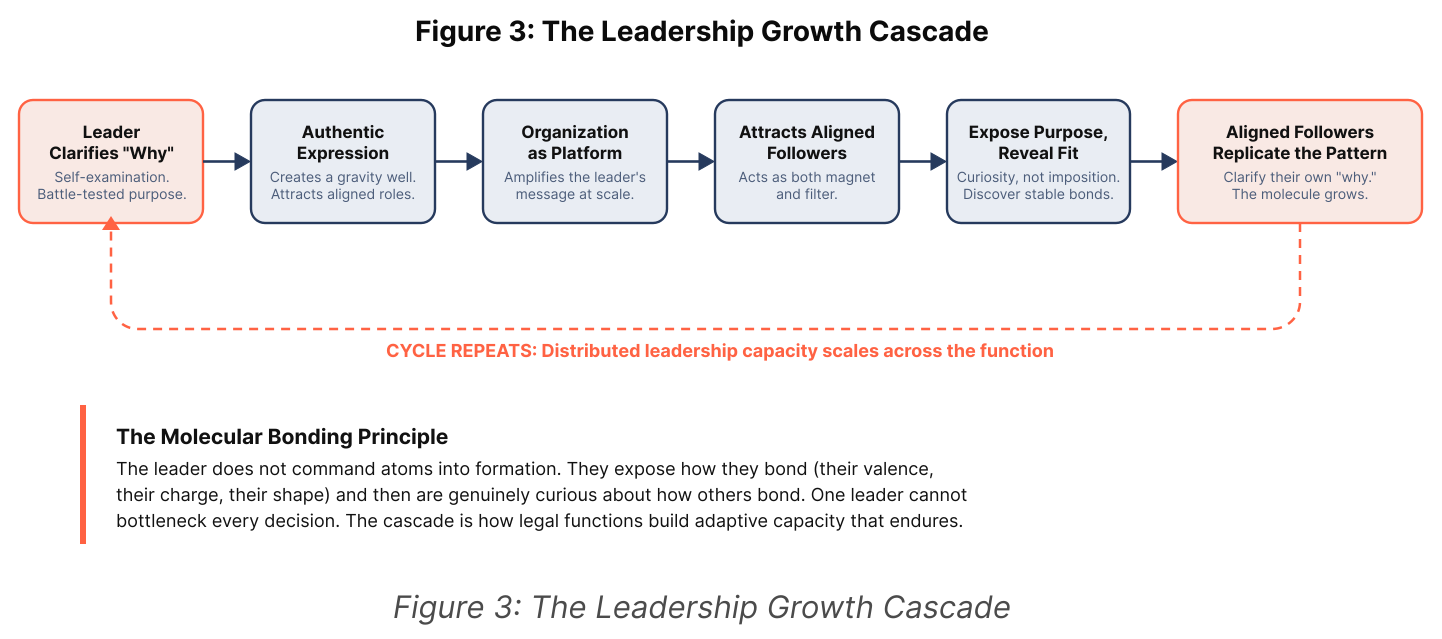
This matters because one leader cannot bottleneck every decision in a transforming organization. If every adaptive choice must route through a single point of authority, the organization’s rate of adaptation is capped at that leader’s personal bandwidth. The above cascade, from clarified purpose to replicated leadership, is how legal functions build the adaptive capacity to sustain transformation beyond any single initiative, led by any single leader, in any single year.
We began this article with a quiet realization: the job is not about better lawyering. We end it with a question that is louder than it appears:
Are you in the right job? And if not, are you prepared to quit today?
This is not reckless advice. It is the logical endpoint of the diagnostic this article proposes. If your purpose is unclear, your environment is misaligned, and your conviction rings hollow, no operating model, no technology platform, and no change methodology will rescue the outcome. You will manage. You will persist. But you will not lead. And the people following you will feel the difference even if they cannot name it.
The good news is that most leaders who work through this diagnostic do not discover they are in the wrong job. They discover they have never deliberately chosen the one they are in. They fell into it through competence and opportunity, the natural career arc of an excellent lawyer, without ever asking whether it was the right script for their capabilities, their values, and the audience they want to reach.
Making that choice deliberately is the foundational operating decision of your leadership.
The next installment examines how to shift from subject-matter expert to executive operating leader. But that shift is only possible if you have answered the question that precedes it:
Why are you leading at all?
- Leadership is not management. Management keeps the system stable. Leadership attracts people to change direction. Know which one you are doing and when.
- Clarify your “why” before you try to lead change. An internalized purpose that can be externalized into mission, vision, and strategy is not optional. It is the fuel for everything that follows.
- Test your purpose against your environment. Product-market fit applies to leadership. Misalignment between your “why” and your organization’s definition of success creates friction that cascades to your entire team.
- Build both credibility and conviction. Law trains you for credibility. Conviction, the external expression of genuine internal clarity, is what makes credibility inspirational rather than merely measured.
- Recognize adaptive challenges for what they are. Nearly every transformation in a legal department is an adaptive challenge, not a technical one. Trust, born of authentic purpose, is the currency that makes adaptive work possible.
- Expose, don’t impose. The most effective leaders reveal their purpose and invite alignment rather than demanding it. Curiosity about others’ “why” builds the stable bonds that scale leadership capacity across the organization.
- Sinek, Simon. Start With Why: How Great Leaders Inspire Everyone to Take Action. Portfolio, 2009.
- Drucker, Peter F. “Managing Oneself.” Harvard Business Review, January 2005.
- Christensen, Clayton M. “How Will You Measure Your Life?” Harvard Business Review, July-August 2010.
- Kotter, John P. “What Leaders Really Do.” Harvard Business Review, December 2001.
- Heifetz, Ronald A., and Donald L. Laurie. “The Work of Leadership.” Harvard Business Review, January-February 1997.
Michael Callier is Managing Principal of Legal and Technology Consulting at UHY Prime. He has led over 100 transformation, technology, and operating model redesign initiatives across legal departments worldwide, with 80 in the last five years alone. His work sits at the intersection of operational design, organizational psychology, and measurable business outcomes.
Jason Barnwell is Chief Product Officer at Agiloft, where he leads a product team that unlocks value from contracts for customers using software and machine intelligence. Previously, he spent over a decade at Microsoft building and scaling legal operations across the company’s legal function, where he became known for the Modern Legal movement, a framework for rethinking how legal departments create and deliver value.
Next in the series: Month 1, The Legal Executive Vantage Point: The Difference Between Excellent Lawyering and Executive Operating Leadership